
Why Kids Give One-Word Answers — And What To Ask Instead
You ask, “How was school?” They say, “Fine.” You ask, “What did you do today?” They say, “Nothing.” You try one more time: “Are you okay?” They shrug and say, “I don’t know.”
It can feel like a wall. Especially when you really do want to know your child, not interrogate them. But one-word answers do not always mean your child is rejecting you. Often, they mean the question is too broad, the timing is off, or your child does not know where to begin.
The goal is not to force a bigger answer.
The goal is to make the next question easier to answer.
By Talk With My Kids · July 6, 2026
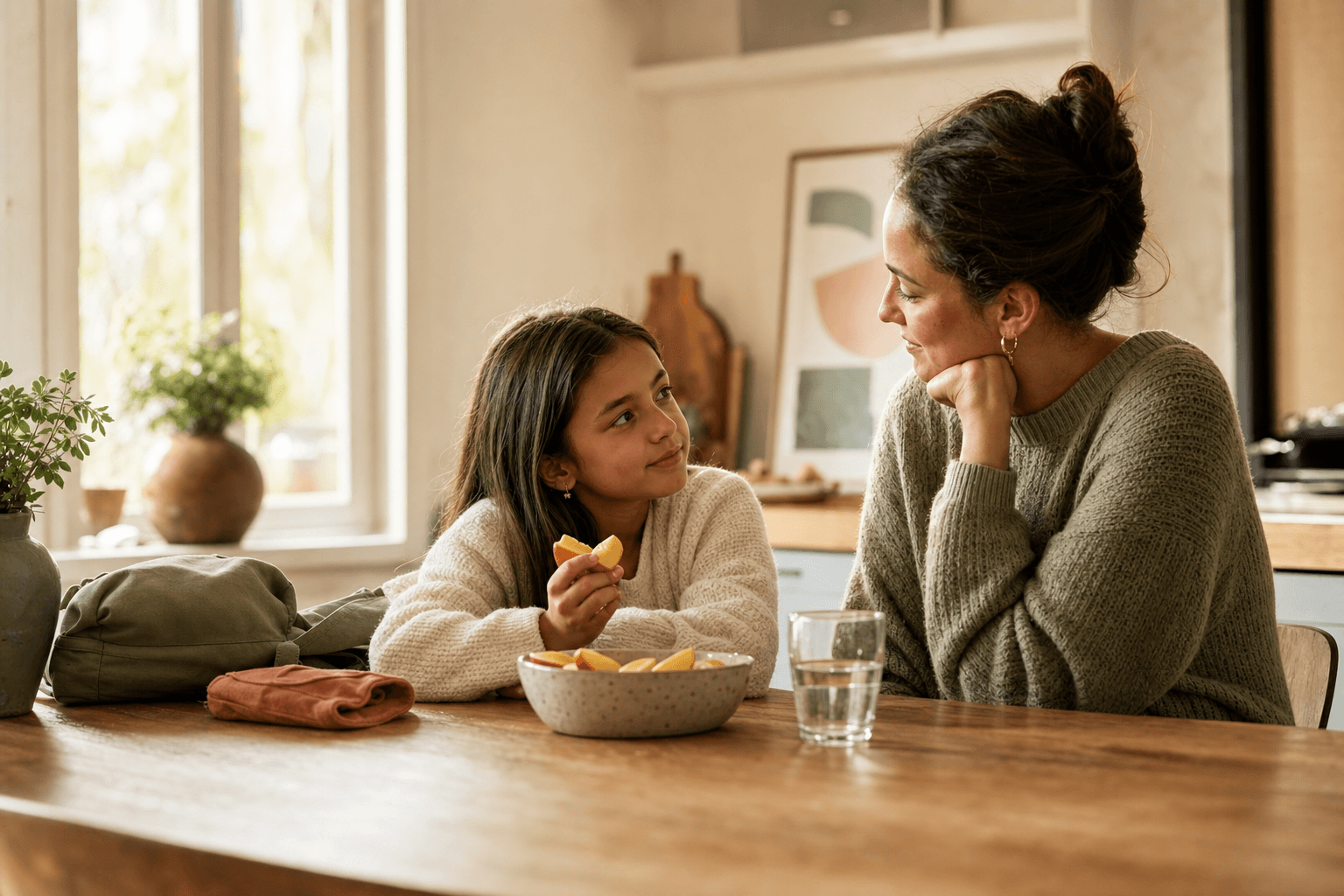
One-Word Answers Are Not Always A Closed Door
A short answer can feel personal. It can sound like your child does not care, does not want to talk, or is trying to shut you out.
Sometimes that may be true in the moment. They may want space. They may be tired. They may not want to talk yet.
But often, one-word answers are less about the relationship and more about the size of the question.
“How was your day?” sounds simple to an adult. To a child, it can mean sorting through school, friends, lunch, recess, rules, mistakes, moments of embarrassment, funny things, boring things, and feelings they have not named yet.
That is a lot to summarize.
A better question gives your child one small doorway into the day.
Why Kids Say “Fine,” “Good,” Or “I Don’t Know”
There are many reasons a child might answer with one word. Some are emotional. Some are practical. Some are simply about timing.
Your child may be:
- tired from holding it together all day
- hungry and not ready to talk yet
- overstimulated by school, noise, screens, or transitions
- unsure which part of the day you actually want to know about
- embarrassed by something that happened
- worried the conversation will turn into advice, correction, or questions
- still processing what they feel
- testing whether the moment feels safe
A one-word answer is not always the end of the conversation. Sometimes it is the first little piece your child can offer.
The Problem With “How Was Your Day?”
“How was your day?” is not a bad question. It is just a big one.
It asks your child to look back across the whole day, choose what matters, decide how honest to be, put feelings into words, and say it all out loud.
That can be hard even for adults.
A more useful question narrows the frame.
Instead of asking your child to summarize everything, ask about one moment, one person, one feeling, or one small detail.
Ask Smaller Questions
Smaller questions are easier to answer because they give your child a starting point.
Instead of
“How was school?”
Try
“What part of the day went by fastest?”
Instead of
“What did you do today?”
Try
“What happened today that you wish I could have seen?”
Instead of
“Are you okay?”
Try
“Was today more easy, hard, weird, or boring?”
Instead of
“Why won’t you talk to me?”
Try
“Do you want a question now, a snack first, or quiet for a bit?”
Smaller questions do not guarantee a bigger answer. But they lower the pressure.
And lower pressure often makes honesty easier.
Questions That Work Better Than “How Was School?”
Try one of these after school, at dinner, in the car, or later in the evening.
After-School Questions
- What part of the day went by fastest?
- What happened today that you wish I could have seen?
- What was one good thing and one hard thing?
- Was there a moment today when you felt proud, annoyed, surprised, or left out?
- What is something you are glad is over?
- Did anything happen today that you are still thinking about?
- What would you change if you could replay one part of the day?
- What was a tiny moment that mattered more than people realized?
For more after-school prompts, use the full guide to questions to ask instead of how was school.
Questions For Kids Who Say “Fine”
- What was the fine part?
- Was it fine-good, fine-boring, or fine-hard?
- What made it fine instead of terrible?
- Was there one part that was better than the rest?
- Did anything make today feel different from yesterday?
- What part of the day would you skip if you could?
- What part would you keep?
- Was there anyone who made today easier?
Questions For Kids Who Say “Nothing”
- Was it a quiet kind of nothing or a boring kind of nothing?
- Did nothing happen, or is it just hard to remember right now?
- What was the smallest thing that happened?
- Who did you sit near, walk with, play with, or talk to?
- What was something you saw, heard, ate, built, read, drew, watched, or noticed?
- If your day had one tiny scene, what would it be?
- What was the most normal part of the day?
- What was the weirdest part?
Questions For Kids Who Say “I Don’t Know”
- Is there one tiny piece you do know?
- Was it more good, hard, boring, funny, or confusing?
- Do you want me to guess a few feelings?
- Should I ask a smaller question?
- Would it be easier to tell me later?
- Is your brain tired, or are the words hard to find?
- Do you want help, comfort, space, or just listening?
- Could you show me with a face, a sound, a drawing, or one word?
For more gentle prompts, visit how to get your child to open up.
Follow The First Answer Instead Of Starting Over
When a child gives a short answer, many parents ask a brand-new question.
“How was school?”
“Fine.”
“What did you do?”
“Nothing.”
“Who did you play with?”
“I don’t know.”
That can start to feel like an interview.
Instead, try following the answer they already gave.
If they say “fine,”, ask:
“What was the fine part?”
If they say “bad,”, ask:
“What was the hardest piece?”
If they say “boring,”, ask:
“What was the most boring part?”
If they say “I don’t know,”, ask:
“Is it a real I-don’t-know, or an I-don’t-want-to-talk-yet?”
Following the first answer shows your child that you are listening to what they actually said, not just pushing for the answer you wanted.
Timing Matters More Than Parents Think
The moment right after school is often not the best time for a big conversation.
Your child may have just spent hours following instructions, managing friendships, sitting still, changing rooms, remembering rules, and holding in feelings. When they get to you, they may need food, movement, quiet, or a little space before words are available.
That does not mean you missed your chance.
The real conversation may happen:
- during a snack
- at dinner
- in the car
- while walking
- while doing dishes
- at bedtime
- while building, drawing, folding laundry, or sitting nearby
Some kids open up once the pressure is gone.
If after school is hard, try again later with a softer question.
You can also explore after-school conversation prompts, bedtime questions, or car ride questions.
Give Them A Choice Before You Ask
Sometimes the best question is not a question about their day.
It is a question about how they want to be approached.
Try:
- Do you want a real question, a funny question, or no question yet?
- Do you want to talk now, later, or not today?
- Do you want help, comfort, space, or listening?
- Do you want me to ask one question or just sit with you?
- Do you want a snack first?
Choice gives your child a little control.
And when kids feel less cornered, they often have more room to talk.
What To Say When They Still Do Not Talk
Sometimes your child still will not answer. That can be hard, especially if you sense something is wrong.
A calm response keeps the door open.
Try:
- I’m here when you’re ready.
- You do not have to tell me everything right now.
- You can start with the smallest piece.
- I care about your day, even if you do not feel like talking yet.
- We can try again later.
- I like hearing your world, even in tiny pieces.
Your child may not respond right away. But they still hear the message:
You are not in trouble for being quiet. I am not going anywhere.
What Not To Do With One-Word Answers
It is understandable to feel frustrated. But some responses make kids more likely to shut down next time.
Try to avoid:
- turning every answer into a lesson
- asking too many questions in a row
- correcting the feeling before understanding it
- saying “You never tell me anything”
- taking the short answer as rejection
- demanding a bigger answer immediately
- making every small share feel serious
A child who shares one tiny piece today may share more tomorrow if that first piece was handled gently.
Try This Instead
Here are small wording shifts that keep the conversation open.
Instead of
“Why won’t you talk to me?”
Try
“You do not have to talk right now. I’m here when you’re ready.”
Instead of
“How was school?”
Try
“What happened today that you wish I could have seen?”
Instead of
“That’s all you’re going to say?”
Try
“I’ll take the small version.”
Instead of
“You’re fine.”
Try
“Something seems a little off. Do you want space or company?”
Instead of
“Tell me what happened.”
Try
“Can you start with one tiny piece?”
Instead of
“I’m just trying to help.”
Try
“Do you want ideas, comfort, or just listening?”
A One-Word Answer Can Still Be A Start
When your child says “fine,” it may not be the whole story.
When they say “nothing,” it may mean they do not know which part to choose.
When they say “I don’t know,” it may mean the words are not ready yet.
The work is not to pull the answer out of them.
The work is to create enough safety, patience, and small doorways that talking feels easier next time.
Start with one better question.
Then listen longer than feels natural.
Related Guides
FAQ
Your child may be tired, hungry, overstimulated, unsure how to summarize the day, or not ready to talk yet. A one-word answer does not always mean they do not want connection.